Tuesday, February 22, 2011

The Ritual of Welcome to Honored Visitors

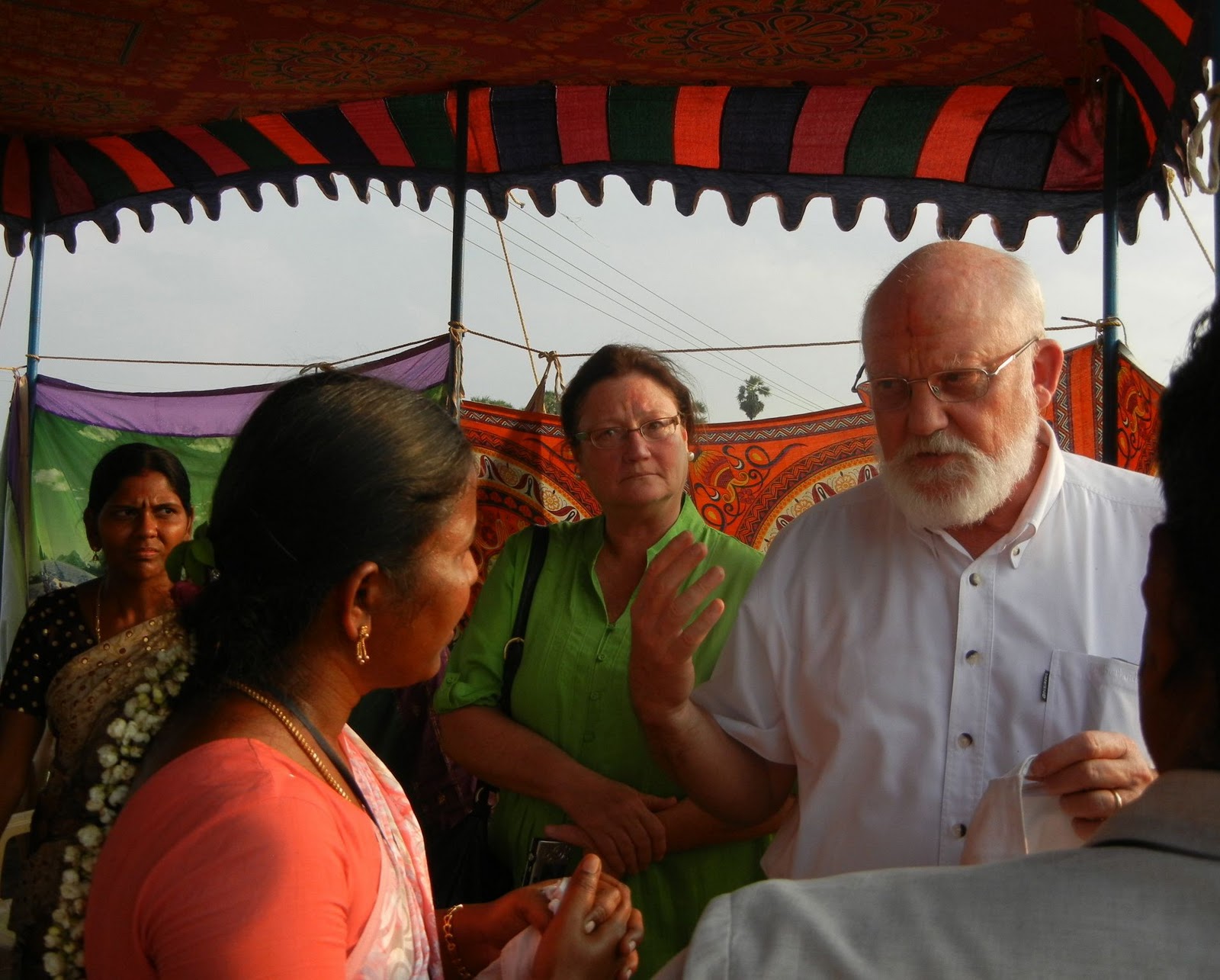
A women's farm workers collective waits for project leaders and staff to arrive,
with cloth-draped table holding fresh fruit and flowers under a canopy for shade,
cameramen at the ready.


Here are a series of photos showing some of the ceremonial ways in which a guest is greeted and welcomed by the Indian host. It is a time-honored tradition that we saw repeated many times over the few days we traveled to view agricultural projects and undertakings related to rice cultivation. Some of the people shown are the farmers themselves who came out and often waited for hours for our party of rice research officials and assorted hangers-on (i.e., myself) to arrive. They appeared friendly and happy to see their efforts receive some attention from people who might be able to offer help. An individual who takes on this work, to aid people to provide needed food for their families, and in a larger sense, for the whole world, takes on a weighty responsibility. I felt this among the youngest and most novice workers trying to reach out with new technologies to farmers in the field, and among the leaders of the ag research institutes and programs, who have been striving to solve the most complex and intractable problems of rice and other crop cultivation under the most challenging conditions, for many many years.

How fortunate we are, that we do not have to lay awake nights and wonder if out children will have enough to eat this week, or this year. It is something that is difficult not to take for granted every day of our lives, surrounded as we are by so many grocery stores and suppliers of so many exotic delicacies.

In a sense, it often felt that some very important contributors were being omitted from the ceremonies of recognition. Yes, leadership and research is critically important in developing the new technologies that will hopefully enable the farmers of the world to produce enough food for all of us in the coming decades and centuries. But I also felt great admiration for the people at each site or farm or research station, who were investing their own sweat and toil in planting, raising and harvesting the trial crops or programs.

Here are just a few vignettes of the rituals we witnessed and participated in, along with some of the farm workers who came out to meet us,  More in the next addition to show you images of farming in India today.

The project leader from Annamalai University and from IRRI arrive.
A large party moves directly to view the fields.


A group of women farm workers who participated in a collective community project to promote ecomonic development and empowerment of women gather to offer their thoughts about how the project is working, and what they desire for their children. Almost to a person, no one wants their children to have to labor in the rice fields, which opens the question of who will perform the labor of staple food cultivation in the future?


A farmer and an NGO worker assisting the women's collective
waits to present their experience to the group.


A STRASA project staff person looks at samples of
new rice strains grown in the field for the first time.
A farm worker and her child


Sons of farmers
Crissan and Barbara draped in ceremonial shawls, meeting with officials at
Annamalai University's  School of Medicine.
The Vice Chancellor honors Dr. Z with ceremonial shawl and garland.

Crissan welcomed and recognized at the same ceremony.


Another project leader is recognized and offered flowers
 along with shawl and garland.


Now turns are taken lighting the ghee in the oil lamp.

At the entrance to the hall where Dr. Z presented his talk about
rice cultivation and world food security, the floor was decorated with
this colorful image made of colored rice grains.


At another location on another day, Dr.Z listens to scientists describe their research projects.


In the field at this next site, taking in the presentations.

At a third site, a sign indicating project focus, growers,
sponsoring agencies, and plan for crops.


A group of farmers drumming a welcome to the inspecting team.
               In this video, farmers welcome Dr. and Mrs Z. to the fields, with ceremonial drumming.

Crissan's favorite part, meeting the women farm workers.


A young plant pathologist and local project leader speak to Dr. Z about a fungus infecting local harvest.


A worrisome harvest points up the fragile system.


A hopeful outlook for an intensive project adding organic nutrients to rice paddies by placing ducks in wire cages over water inlets to fields, and introducing fish into the water system, so that the farmer gains higher rice yield, and has ducks  and mature fish to sell at the end of the season as well.


What the ceremonies and meet-and-greets really celebrate is the creativity and drive that have been harnessed in the effort to find and disseminate new ideas, approaches and technologies to assist farmers to grow more rice or other staple crops, with less water, on less land, with less labor, under greater stresses from climate change, so that there will be foods with sufficient nutritional value to sustain the ever-increasing number of people in our world. Food security is a most basic necessity, before any other level of security can be sustained. Progress toward such a goal is certainly worthy of honoring, whether in ceremony and ritual or in small individual acts of contribution to our greater welfare.

Monday, February 21, 2011

Some Glimpses of Rural Village Life in Southern India

Business district

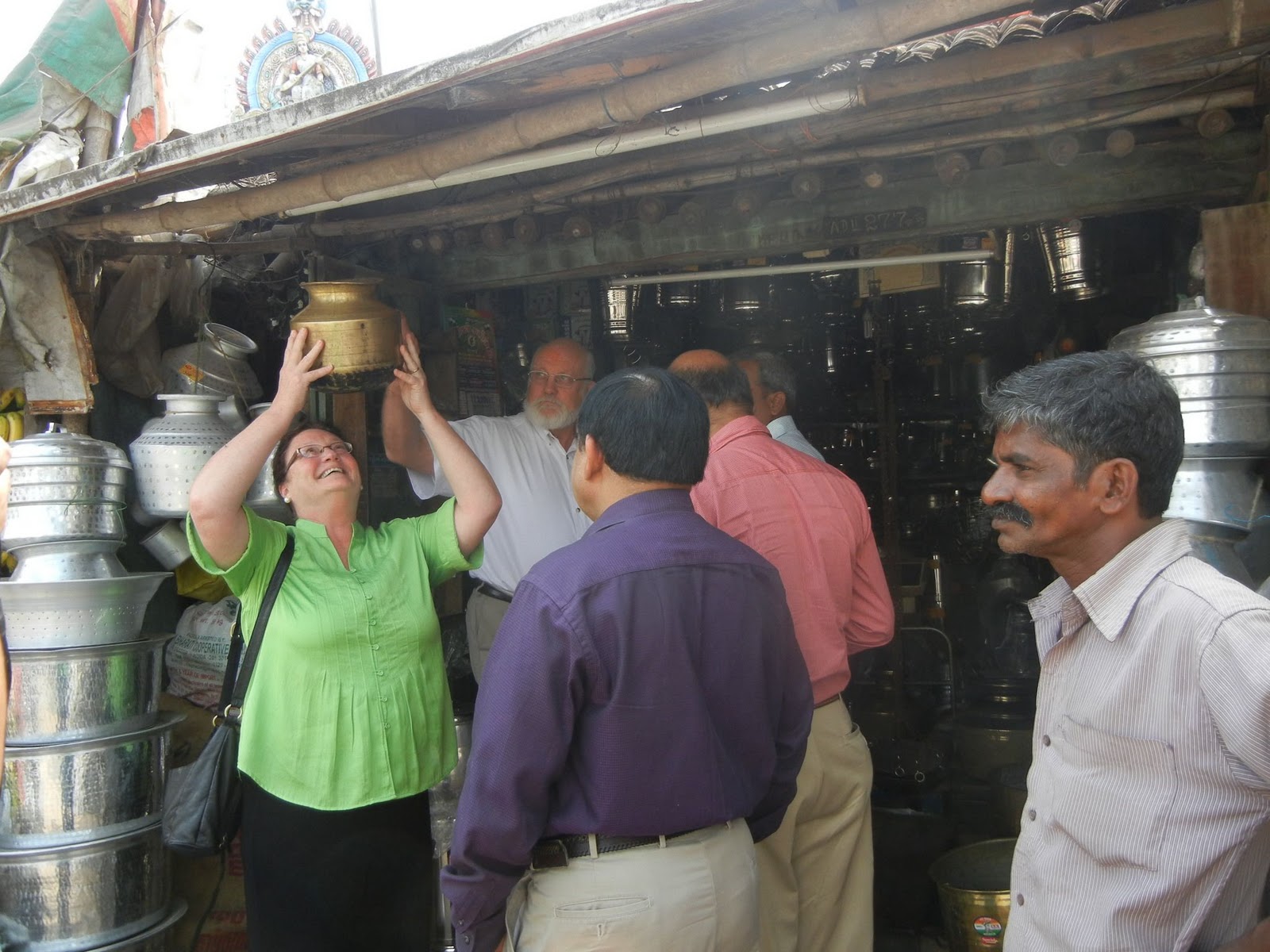
Crissan, finding the treasured antique brass water urn

A Shrine or Icon to a Deity sits near every store entrance.


Selling jasmine and other fragrant flowers outside a temple

A colorful home, typical of Tamil Nadu

A bit blurry, but to show you another popular color scheme for a house

Even the poorest home can find a place for color


Miami?

Faces of India

credit to Crissan for this photo

another by Crissan


and another by CZ


and another from CZ


Handloom Weaving

In India, much weaving is already done by automated machines, but there still exists a cottage industry for very skilled artists and artisans. Again through Crissan's artful pleading, we were introduced to a couple who are Agriculture Department Extension workers, supporting the continuation of handloom weaving in one small village. I just went to look at the box from the retail store that sells this weaving in order to identify the village, but the entire label is in the Tamil language, with an inscrutable alphabet of a mere 226 distinct letters! So, that will have to remain unnamed.


We first were greeted at the home of the extension workers, who then took us to two homes where very large handlooms were in use to weave silk sarees.

Crissan at the front door of this home.


One loom was somewhat automated so that the shuttle was shot back and forth across the width of the loom with each shift of the presser bar.

I got to sit at the loom at see the process up close.

The weaver at his loom. He is wearing a
dhoti, a skirt-like wrapping frequently worn by men in this part of India.
Exquisite silk in blue, bronze and gold


The other loom required two people to manage, so the husband did the more strenuous part and the wife sent the shuttle back when it reached her side. This couple had two very beautiful daughters, the older of whom was 10 or so. She began to weep after we came in to see the weaving. A translator explained that she was fearful that we were there to steal her parent's weaving design secrets, a very valuable asset that weavers try to keep safe at all times. Losing the secrets can apparently mean financial ruin, so the child was terribly worried. I hope she was able to trust the explanation that we were not there to cause trouble for her family. It pointed out for me how precarious success can be in village life, and how early a young person becomes aware of her lack of security.
Such beautiful girls!

Ama and Apu, i.e., Mom and Dad, at work in the front room.


Next we traveled to the main street of the village, where the artist-designer and his wife run a saree shop, selling his beautiful designs, often for weddings. While we were there, a large group came in, a young bride-to-be, her father and mother and many of her extended family members. It was clear that choosing the saree was the father's domain, and the others were there to observe.
The artist showed us pages of pencil sketches that he uses for inspiration for his fabric designs, many of them taken from images carved into temples, which yield a rich array of subjects, styles and patterns to choose from. The artist's wife mainly ran the shop, and spoke very good English, and was also involved in finding purchasers in Chennai and in more distant places such as Italy. Although the business was very village-centered, the product was by no means restricted to local distribution. We, of course, availed ourselves again of the opportunity to support a local economy and its skilled artists and artisans.

This is a very modern young woman, with the most stylish short haircut I saw anywhere on my travels. Her husband's design work was also quite striking, and ranged from the traditional to quite modern geometric styles and patterns.