Monday, February 21, 2011

Some Glimpses of Rural Village Life in Southern India

Business district

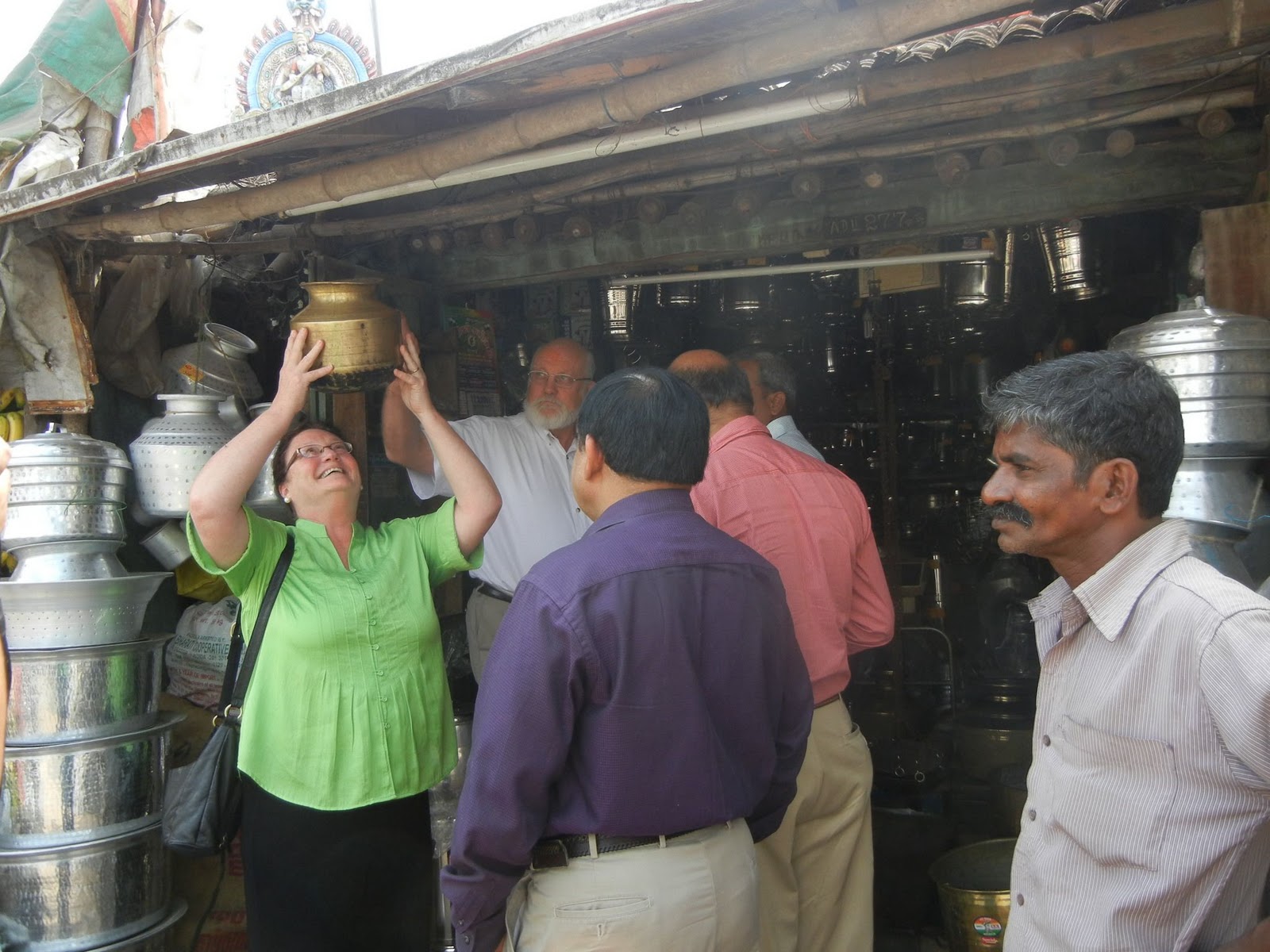
Crissan, finding the treasured antique brass water urn

A Shrine or Icon to a Deity sits near every store entrance.


Selling jasmine and other fragrant flowers outside a temple

A colorful home, typical of Tamil Nadu

A bit blurry, but to show you another popular color scheme for a house

Even the poorest home can find a place for color


Miami?

Faces of India

credit to Crissan for this photo

another by Crissan


and another by CZ


and another from CZ


Handloom Weaving

In India, much weaving is already done by automated machines, but there still exists a cottage industry for very skilled artists and artisans. Again through Crissan's artful pleading, we were introduced to a couple who are Agriculture Department Extension workers, supporting the continuation of handloom weaving in one small village. I just went to look at the box from the retail store that sells this weaving in order to identify the village, but the entire label is in the Tamil language, with an inscrutable alphabet of a mere 226 distinct letters! So, that will have to remain unnamed.


We first were greeted at the home of the extension workers, who then took us to two homes where very large handlooms were in use to weave silk sarees.

Crissan at the front door of this home.


One loom was somewhat automated so that the shuttle was shot back and forth across the width of the loom with each shift of the presser bar.

I got to sit at the loom at see the process up close.

The weaver at his loom. He is wearing a
dhoti, a skirt-like wrapping frequently worn by men in this part of India.
Exquisite silk in blue, bronze and gold


The other loom required two people to manage, so the husband did the more strenuous part and the wife sent the shuttle back when it reached her side. This couple had two very beautiful daughters, the older of whom was 10 or so. She began to weep after we came in to see the weaving. A translator explained that she was fearful that we were there to steal her parent's weaving design secrets, a very valuable asset that weavers try to keep safe at all times. Losing the secrets can apparently mean financial ruin, so the child was terribly worried. I hope she was able to trust the explanation that we were not there to cause trouble for her family. It pointed out for me how precarious success can be in village life, and how early a young person becomes aware of her lack of security.
Such beautiful girls!

Ama and Apu, i.e., Mom and Dad, at work in the front room.


Next we traveled to the main street of the village, where the artist-designer and his wife run a saree shop, selling his beautiful designs, often for weddings. While we were there, a large group came in, a young bride-to-be, her father and mother and many of her extended family members. It was clear that choosing the saree was the father's domain, and the others were there to observe.
The artist showed us pages of pencil sketches that he uses for inspiration for his fabric designs, many of them taken from images carved into temples, which yield a rich array of subjects, styles and patterns to choose from. The artist's wife mainly ran the shop, and spoke very good English, and was also involved in finding purchasers in Chennai and in more distant places such as Italy. Although the business was very village-centered, the product was by no means restricted to local distribution. We, of course, availed ourselves again of the opportunity to support a local economy and its skilled artists and artisans.

This is a very modern young woman, with the most stylish short haircut I saw anywhere on my travels. Her husband's design work was also quite striking, and ranged from the traditional to quite modern geometric styles and patterns.

Annamalai Guest House Kitchen

One of the many wonderful things about traveling with Crissan is her amazing ability to persuade our hosts to show her "behind the scenes" places, places that show what life might be like for ordinary people in whatever community we are visiting. The hosts have a hard time believing such things could possibly be of interest to their esteemed guests, but somehow, Crissan is able to turn the path toward what she really wants us to see. Thus, we had a brief tour the the kitchen at Annamalai University, where the Ag Department had invited Bob to come and give a talk. A large dinner was planned for the evening after the talk, and preparations were already underway early that day.

Note the large green jar on the left - a water urn. On the table, toward the rear, the main chef's spice box, with divided compartments containing all the essentials for southern Indian cooking, which does indeed rely on very strong spices. Another tool, the dark wooded object with two handles and a brass plate on its side, is a rice noodle extruder. The brass piece is perforated with tiny round holes, and a paste made of rice flour and water is pressed through the cylinder. Rice is eaten in some form at every single meal in southern India.
Crissan, curious about the spices.


One of many cooks, chopping onions. Note the narrow wood plank used as a "cutting board," another one is visible closer up on the empty tray. The chopped pieces just fall away onto the tray. Simple but efficient!


This is a grater, next to the shoes on the floor, used by kneeling to put lots of muscle into it.

And this fine piece of machinery is in use to make a rice dish called "itli," made by mixing a fermented rice batter until very well aerated in these mixers, then somehow steamed into small bread-like cakes of pure white, with a spongy texture and very mild flavor, eaten after dipping into very hot spicy chutneys of coconut, red pepper and other things. Most often eaten for breakfast.

You may notice how loud the background noise is in the video - lots of people talking all at once - the normal state of things!

Sunday, February 20, 2011

Mammalapuram Temple

Heading south from Chennai along the coastal road we caught our first glimpses of the Bay of Bengal. We had been met by a professor from Annamalai University's ag department, who had been drafted as our tour guide, along with a driver. A professional driver seems essential after what I've seen of traffic in India. DO NOT try this at home!

We took the coastal road rather than the main highway because it took us to the site of the ancient temple of Mammalapuram. It was built mainly during the 7th to 9th centuries, under the Pallavi dynasty - think of what Europeans were doing around 600 AD . . . and carved mainly out of huge granite outcroppings "in situ," right where they found them.

This is what we first saw as we approached an outlying site called "The Tiger Cave."


Walking around these big boulders to the left, this is what we came upon.


Here we are, me, one of the IRRI team who traveled with us, and Crissan.


This one is another whole section, a short walk away from the Tiger Cave.

In the place of honor inside this cave is a black obsidian sculpture of a "lingam," revered as one of the avatars taken by Shiva, one of the Hindu deities, a symbol of "male creative energy." The "yoni,"visible here as the ring through which the lingam rises, is the symbol of "female creative energy" associated with the goddess Shakti. Seen together as here they can symbolize the duality of nature or infinity. (see http://en.wikipedia.org/wiki/Lingam, briefly quoted here, for more detail.) This symbolic form crops up again and again in India. Note the fresh flowers adorning the top, indicating a recent offering of reverence or respect for the spirit of the Lingam.
Here's another stone suggesting the same linga form, but naturally occurring, with some small marks from a granite carver at some time in the past.
A little further on, nearing the sea shore, we came upon this huge piece of granite. It was uncovered only recently, as a result of the terrible tsunami of December 2004. You can see the faint line showing where the ground surface used to be, about midway up the rock.
Below that line, you may be able to make out some faintly carved parallel lines in the rock, most easily seen in the shadowy side to the lower left. A knowledgeable observer realized that this suggested the possibility that this too was a part of the temple system, and an archaeological dig is now under way.

 And here is that same rock seen from the other side, with temple walls and other structures revealed around it.

 Since we were now just a few steps from the shore, we walked out to the Bay. A fishing boat was pulled up on shore, and if you look closely you may see some others with the similar high-prowed shape out on the water.


Next we drove into the town of Mammalapuram, where we saw several more granite structures carved in amazing form and detail, all telling stories of the deities and the land.


The vertical division to the left of the elephant is said to represent the Ganges River.
There seems to be some disco dancing going on here.

And as always, cows are in fashion. Milking time here.


Note the free-standing leg on this otherwise bas relief work.
One of many guides our host hired to tell us about what we're seeing.


In this carving at the base of a pillar, we see an antelope with a calf, but now cover the calf and the head of the mother. Do you see an elephant? NOTHING in India is what it seems . . .


This huge boulder is said to be immovable even by mechanical means.
Here we see a group of lions with a range of influences, a sphinx-like creature on the left and a Roman influence in the one to the right.

This is known as the Sea Shore Temple, as it built on high ground overlooking the Bay of Bengal. It is a structure built of assembled pieces of stone, and was apparently at one time washed into the sea and reconstructed!

And finally, one last lingering look at yet another lingam . . .