Sunday, February 13, 2011

For Dave: See? I'm checking the safety cards.


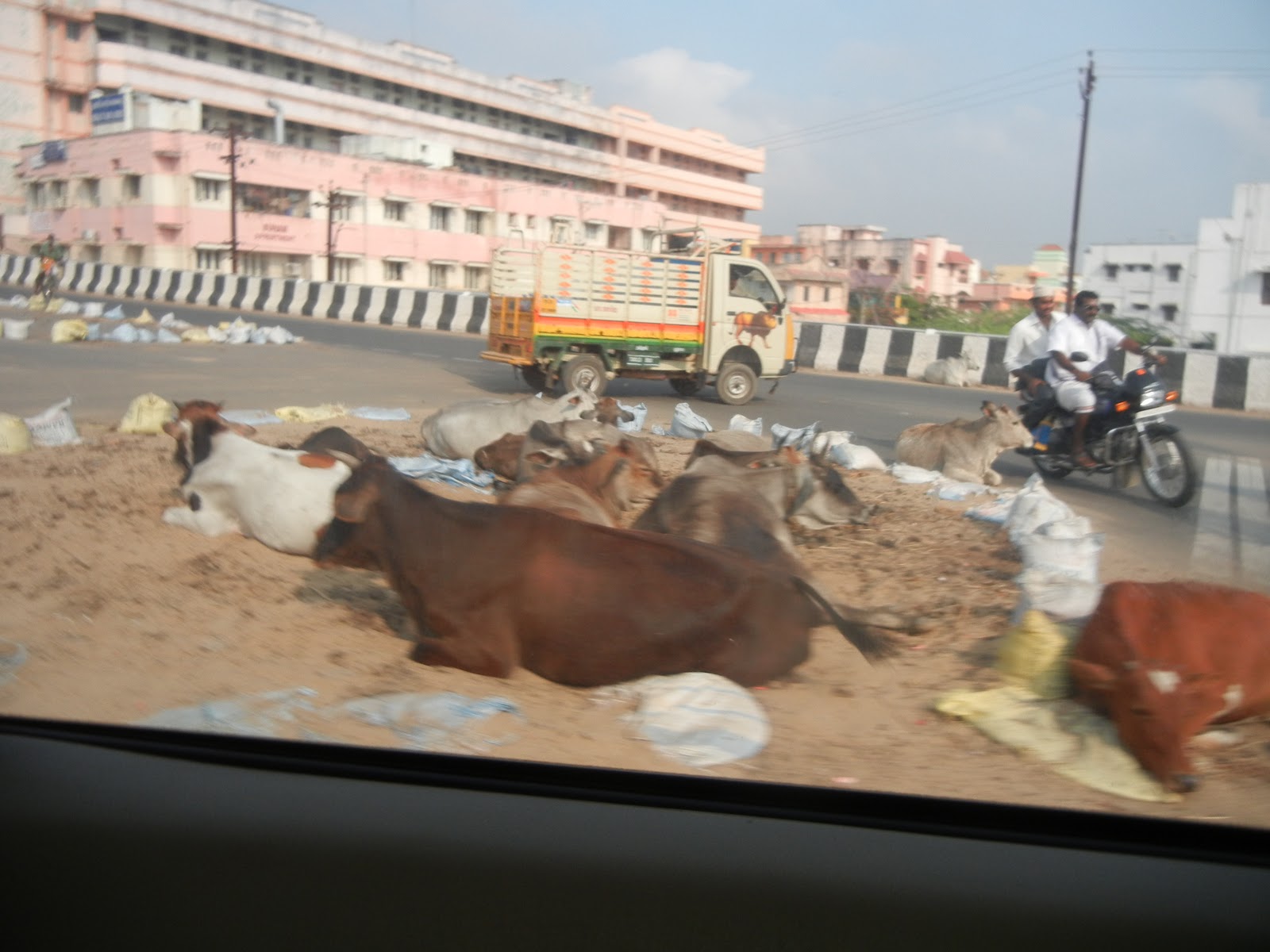
Cows and their contributions. . .


Beast of burden - water buffalo yoked to a cart.


Cows in the median!


Look closely - a whole herd crossing a divided highway


Just roaming the streets as they wish

and some of the artful storage techniques for fuel


like so many hubcaps


And Some That I Did Get to Take -

 The MacDonald's experience in India


The crouching position that seems to be the favored position for being still

Can you tell who is real and who is statue?


Some shopping experiences

Flower seller

a narrow alley at the "mall"

Trying my hand at the expected haggling

I came around the corner and who should I see but Bill and Hil - small world!


Friday, February 11, 2011

Pictures I didn't get to take


On the road from Delhi to Agra today, at first I thought I’d swear off using my camera for a time and just sit back and witness this wild environment of extreme strangeness. After a few moments of this nonsense, however, my hand reached for the camera. But, for the most part, my first impulse was truest, since we traveled so quickly that no sooner had I registered a scene I wanted to record, and tried to aim the camera and shoot, than it was transformed into a thing of the past, a memory, vivid but unrecorded. So here, my attempt at non-digital recording:

Women in orange, vivid turquoise and magenta saris walking through waist-deep fields of bright green mustard plants, tiny graceful points of color against a beautifully textured field.


Cow dung as an art form: the first, most startling image was of circular “cow patties” laid out to dry along the roadside near a stretch of small businesses, looking like so many hubcaps lost along a bumpy stretch of highway. Later forms of dung storage include a dome-like mound about 5 to 6 feet tall, with the flat circular shapes standing on edge but at a slight angle, alternating directions with each layer, creating a herringbone pattern when viewed from the side. Yet another, seen within the city limits of Agra: women carrying huge bowls, at least 3’ in diameter, atop their heads, filled high with stacks of dung circles like so many loaves of bread. All for use as fuel, in this country where nothing goes to waste.


My favorite scene of crouching man – a figure in turban and shawl crouched tightly atop a wall of a partially built – or un-built – building near the roadside, as if guarding the vacant overgrown space within the walls.

Many many women walking with huge loads of produce, firewood, or bundles of mysterious goods wrapped in bright silk or plastic tarp sheets, balanced atop their heads.

Children hand-in-hand gaily skipping along the street.

Schoolgirls in uniforms of bright pink loose-fitting pants and shoulder wraps with black blouses, fluttering by in groups of two or three or five, carefree and sprightly.

Wile E Coyote’s supplier: a 4 or 5 story brick factory building standing out in the middle of rural wheat and mustard fields, far from any vestige of urban surroundings, with a large ACME posted at the top – this must be where Wile E Coyote gets his TNT!

A man pedaling a bicycle down the dusty road, with a huge tractor tire strapped to the rear fender, standing on edge and perpendicular to the bicycle itself, like a circular backdrop, creating an oddly shrine-like frame around the rider.

Thursday, February 10, 2011

A Lost Day

One day in Lucknow, entirely lost to a case of Shiva's Revenge -- I guess I needed a break from the sometimes overwhelming chaos and contradictions of the culture here! Thankfully I've recovered can again count myself as human.

Pictures to come when I have time and wireless access at the same point!

India, the Original Stream of Consciousness


I am struck by the constant streaming motion through all the streets I have traveled along thus far in my journey, in Delhi and  in Lucknow, and I expect in every future place I am privileged to experience here.  Rushing, pulsing traffic of every imaginable kind of vehicle and creature are all thrown together in their earnest efforts to get where they are going, carrying whatever needs to go there. Teams of people are, more often than not, crammed into the three-wheeled rickshaw carts, perched atop bicycle handlebars, on horseback, on mo-peds; women in saris and burqas sit side-saddle on rear fenders of bikes and motorcycles, a tiny child squeezed between the driver and the handlebars. This evening, a passenger on the rear of a motorbike was holding a 10- or 12-foot piece of pipe or tubing with some kind of fabric rolled around it, holing it up like a flagpole as the bike rushed down the street and in and out of bottlenecks of cars and lorrys and buses. Rickshaws appear out of nowhere piled high with huge loads of boxes, packages, and sacks stuffed to bursting, all held precariously together with a series of bungee cords, while the driver stands up to pedal the bike-cart, in order to gain enough leverage to move his load.  And everyone managers to avoid the cows, standing placidly in the middle of the busy street, jaws working but feet fixed in place, oblivious to it all.

So, the crowds rush by, and occasionally you see, for instance, a small girl of 10 or so, dressed crisply in a navy blue and white school uniform of skirt and blazer, pedaling a bicycle against the traffic flow off to one side of the street, with posture erect and a perfect aura of unhurried calm about her, purposeful in her progress but not frenzied or hurried, remote in her spirit, not turning her head but fixing her gaze straight ahead, seeming to know that she will arrive at her destination at the fated time, no sooner and no later, while all around her the frantic honking of vehicles attempting to assert their right-of-way raises a chaos of sound filling the atmosphere. Such an island of calm in the floodwaters of humans in zealous pursuit of their purpose presents an odd juxtaposition that I’ve seen again and again here, personified in a variety of forms.

People who decide to stop moving forward for whatever reason, often seem to freeze into a low crouch, at whatever point on the globe they have determined to be their place of rest. Often they crouch so low to the ground that they seem to be emerging from it, as if the earth opened up just wide enough to allow the head, then shoulders, then most of a torso to rise up above the surface. No further motion is apparent then, as if all progress has come to a halt, suggesting a people only partially born to our planet, rooted to the earth as a plant might be, destined either to thrive or fail there in that very spot. Rarely have I witnessed an individual arise from such a crouching position. I suspect that this is perhaps because they are most often seen when I am actually rushing past them, carried along in the rush of traffic, so that my view is necessarily fragmented and spliced together as my head turns back and forth to take in as much as I can, while other vehicles first block my view and then move out of the way.

Fragmented, frozen, rushing, teeming images clashing and complex, as hard to follow or make sense of as Joyce in high form; the only solution is to sense, just to sense.  Open the senses and let the stream run through, nourishing a primal joy.

Old Lucknow


Another incredible day, starting with a meeting with a PhD student in Psychology who is working on her dissertation concerning  the use of a drawing task as a diagnostic tool for children, hoping to discriminate between 5 major psychiatric disorders by reviewing formal aspects of their artwork. One of my colleagues at Children’s put us in touch, coincidentally just a few weeks before my trip. It was exciting to make a connection with an individual halfway around the world, regarding our professional focus. We both hope it will lead to future collaboration or an exchange program to help introduce the field of art therapy formally in India, where as of now it does not exist as a distinct clinical specialty.

Then, at noon, off to Lucknow via a short flight, to accompany my friend’s husband to an agricultural conference in the capital city of Uttar Pradesh, India’s largest and most politically influential state. As the Director General of the staple food crop research program that has been Bob’s focus for the last many many years, we were greeted as dignitaries, offered lovely bouquets of gladiolus blooms and roses,  whisked through a crowd of others awaiting passengers from the terminal, into a white Ambassador car with curtains on the side windows, plush patterned upholstery and a red light and “dignitary” flag on the hood, and driven to the guest house where we are being housed for this night of the conference.
Our classy ride!

Once reunited with our luggage and established in our guest rooms, we were provided with a tour guide, a young woman who also happens to be a social scientist, a “gender specialist” whose life work over the past nearly 20 years has been to interview and study the lives of women who are rice farmers or whose families farm rice.  She seemed not to mind being cast in the role of “entertainer of spouse and friend of dignitary” and told us a little about her work, which has truly covered uncharted ground in opening a relationship with women who actually do much of the farming but have generally been illiterate and have not availed themselves of some of the advances in knowledge about farming. Due to the relationships that this young woman has worked to establish and maintain over many years, many of these women are now coming to gain access to the fruits of recent research and outreach efforts to increase the yield of their crops.
Abha, our generous and enthusiastic guide

Aside from that we did a little shopping! Lucknow is known for a particular style of fabric work using a very soft muslin fabric and hand embroidery, called "chickan" work, a cottage industry performed by women to supplement their family income. The embroidery is very fine, though no longer so extremely fine and elaborate as the 40-year old samples the purveyor showed us from his grandfather’s time, work so finely done that you can barely see the threads used to create flowery patterns and open work made by pulling apart the weave without breaking through either warp or weft of the weave, very very delicate work, beautiful to behold. And of course we found it our civic duty to purchase some of these fine garments, at a minimal discount from the asking price despite the best efforts of our host-guide to negotiate a lower price. Fair is fair, after all, and these workers are not well-paid to begin with so we could not object and were pleased with our choices.
One of the women who embroider this beautiful fabric

Looking over the handwork with our guide and translator